Stratis Intelligence · 2026
Stratis Intelligence · 2026
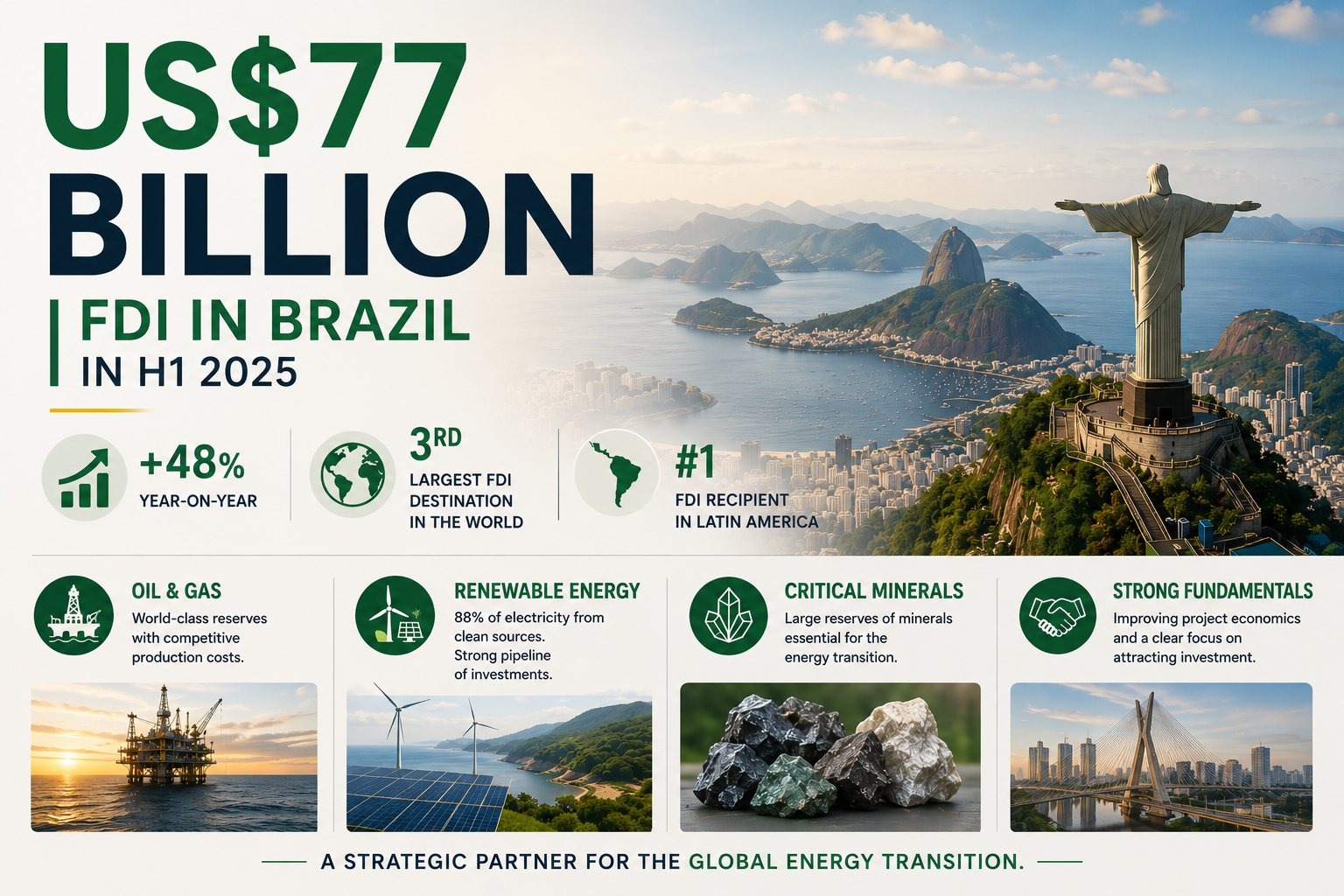
In the first half of 2025, Brazil attracted US$77 billion in Foreign Direct Investment — a 48% increase year-on-year — securing its position as the world's third-largest FDI destination and Latin America's top recipient, according to OECD data. Full-year inflows between January and November reached US$84.1 billion, the highest since 2014.
This performance is not accidental. It reflects the convergence of structural advantages that position Brazil as a uniquely complete platform for global capital at a moment when the world is simultaneously managing energy security and accelerating the transition away from fossil fuels.
International capital is increasingly looking for jurisdictions that offer both scale and long-term strategic relevance. In an environment of geopolitical fragmentation and accelerating energy transition pressures, the list of markets that can deliver both is short. Brazil is on it.
The country offers a rare combination: it can supply the energy of today — through pre-salt oil and gas — and the materials of tomorrow — through its critical mineral deposits — while simultaneously building one of the world's most advanced renewable energy infrastructures.
"For global investors, the question is no longer whether Brazil belongs in the portfolio. It is how much — and through which vehicles."
According to data from Brazil's Central Bank and the Ministry of Development, the sectoral distribution of 2025 FDI inflows reflects a clear shift in investor priorities:
Brazil's performance in H1 2025 is particularly striking given the global backdrop. Total global FDI flows in the first half of 2025 reached US$663 billion — 6% below levels recorded a year earlier. Emerging and developing economies saw greenfield investment decline by 24%. Brazil bucked that trend decisively, recording a 48% year-on-year increase and positioning itself as one of the few large emerging markets attracting significantly more capital than in the prior period.
The data
FDI inflows — US$ billion
Brazil FDI trend 2020–2025
* H1 2025 · Source: OECD / Banco Central do Brasil
FDI by sector — 2025
Where the capital is going
Source: BCB / Planalto · 2025
Stratis View
The 2025 FDI data confirms a structural inflection, not a cyclical spike. Brazil is no longer competing for capital on price alone — it is competing on strategic positioning. The combination of resource depth, improving project execution, and policy momentum has created a window that sophisticated investors are increasingly moving to capture.
For investors building exposure to the energy transition, the question is no longer whether Brazil belongs in the portfolio. It is how much — and through which vehicles. The sectors driving the highest long-term returns are energy and mining, and Brazil offers access to both at a scale and cost structure that few markets globally can match.
Sustaining this momentum will require continued focus on regulatory predictability, infrastructure development, and a balanced investment environment. The conditions are in place. The execution risk remains — but for those with the analytical capacity to navigate it, the opportunity is significant.
Brazil is open for business. The question is whether global capital is paying attention.
Need deeper intelligence on
Brazil's energy and mining sectors?